Character Profile
MY HAMLET

My two main parts of this play happen near the start and near the end. I have scene 4, where Hamlet pretends to have an odd disposition when he is speaking to Polonius. He also talks to Laertes, and figures out that he was sent by the King to spy on him. In this scene, Hamlet is still grieving his father and I think this is some of the motivation behind him acting so strangely. In scene 12, my other scene, Hamlet is angry. He has made the decision that he will eventually kill Claudius. His anger towards Claudius slowly develops from the first scene, and I think scene 12 is one of the first points where he really lets it out. I think the fact that he bottles everything in for a very long time is eventually what drives him mad. Hamlet is an intelligent man and I think it takes a lot for him to really unleash his feelings. I feel like I should be careful on how I use Hamlet's anger, considering his intelligence, I feel that he might be a lot more conserved at points. There is also a type of wit behind his lines which I really want to try and capture. Andrew Scott's performance as Hamlet was outstanding and he really managed to capture the wit and the jokes that Hamlet almost tells to himself.
I wanted to further my character development further, so I decided to look at Laban Efforts. It helped me to find new ways to physicalise my character. For a long time Laban movement was primarily used for dancers and dance choreography to discover new ways to move. In the 80s and 90s, it began being used to help actors and improve performances. The Eight Efforts help an actor both physically and emotionally identify and play characters who are different from themselves.
The Eight Efforts:
Wring
Press
Flick
Dab
Glide
Float
Punch
Slash
STANISLAVSKI QUESTIONS
Who am I?
Hamlet, Prince Of Denmark, rightful heir to the throne but that has been taken from me by my uncle who has married my mother.
Where am I?
Denmark, my bedroom.
What time is it?
Now. Hamlet is now. It's 5 in the morning.
What do I want?
People to understand me, to be rid of the pain and anger, to have my dad back, for my uncle to be dead.
Why do I want it?
Because it is right to avenge my father after he has been murdered. People have wronged me and my family and have gotten away with it, which shouldn't be allowed.
How will I get what I want?
By any means possible, murder.
What must I overcome to get what I want?
SOURCE: Shakespeare-online
Hamlet
Hamlet is arguably the greatest dramatic character ever created. From the moment we meet the crestfallen prince we are enraptured by his elegant intensity. Shrouded in his inky cloak, Hamlet is a man of radical contradictions -- he is reckless yet cautious, courteous yet uncivil, tender yet ferocious. He meets his father's death with consuming outrage and righteous indignation, yet shows no compunction when he himself is responsible for the deaths of the meddling Rosencrantz and Guildenstern, and the pontificating lord chamberlain, Polonius. He uses the fragile and innocent Ophelia as an outlet for his disgust towards the queen, and cannot comprehend that his own vicious words have caused her insanity. Hamlet is full of faults. But how is it that even seemingly negative qualities such as indecisiveness, hastiness, hate, brutality, and obsession can enhance Hamlet's position as a tragic hero; a prince among men? To answer these questions we must journey with Hamlet from beginning to end, and examine the many facets of his character.
HAMLET AT THE ALMEIDA
I saw Hamlet at the Almeida which starred Andrew Scott playing Hamlet. He was really enjoyable to watch however I felt he had wasted some lines. He added a really nice wit to Hamlet and wasn't too intense.
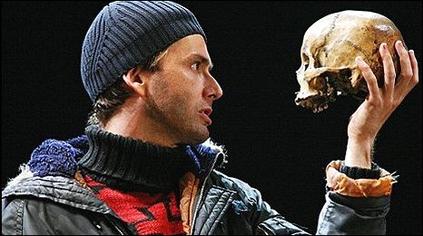
David Tennant holding André Tchaikowsky's skull, during a performance of Hamlet at the RSC.
CLAUDIUS
Hamlet's hatred toward Claudius grows significantly and at quite a pace. In the beginning of our play, he taunts Hamlet and tells him his grief is "unmanly". This instantly sets a patronising tone and Hamlet dislikes his Uncle from the get go.
OPHELIA
Hamlet loves Ophelia but when his father dies, he finds it very difficult to express his feelings. He is in a very bad place and he pushes her away, there is also the theory that Hamlet sexually assaulted her.
POLONIUS
Being Ophelia's father, Hamlet always resented Polonius. Polonius tried to spy on Hamlet after finding out what he did to Ophelia and Hamlet messes with him.
LAERTES
Laertes is a very good friend of Hamlet's, but after Hamlet finds out he is sent to spy on him, Hamlet is bitter toward him. Laertes is also not keen on Hamlet being with Ophelia.
My two main parts of this play happen near the start and near the end. I have scene 4, where Hamlet pretends to have an odd disposition when he is speaking to Polonius. He also talks to Laertes, and figures out that he was sent by the King to spy on him. In this scene, Hamlet is still grieving his father and I think this is some of the motivation behind him acting so strangely. In scene 12, my other scene, Hamlet is angry. He has made the decision that he will eventually kill Claudius. His anger towards Claudius slowly develops from the first scene, and I think scene 12 is one of the first points where he really lets it out. I think the fact that he bottles everything in for a very long time is eventually what drives him mad. Hamlet is an intelligent man and I think it takes a lot for him to really unleash his feelings. I feel like I should be careful on how I use Hamlet's anger, considering his intelligence, I feel that he might be a lot more conserved at points. There is also a type of wit behind his lines which I really want to try and capture. Andrew Scott's performance as Hamlet was outstanding and he really managed to capture the wit and the jokes that Hamlet almost tells to himself.
I wanted to further my character development further, so I decided to look at Laban Efforts. It helped me to find new ways to physicalise my character. For a long time Laban movement was primarily used for dancers and dance choreography to discover new ways to move. In the 80s and 90s, it began being used to help actors and improve performances. The Eight Efforts help an actor both physically and emotionally identify and play characters who are different from themselves.
The Eight Efforts:
Wring
Press
Flick
Dab
Glide
Float
Punch
Slash
STANISLAVSKI QUESTIONS
Who am I?
Hamlet, Prince Of Denmark, rightful heir to the throne but that has been taken from me by my uncle who has married my mother.
Where am I?
Denmark, my bedroom.
What time is it?
Now. Hamlet is now. It's 5 in the morning.
What do I want?
People to understand me, to be rid of the pain and anger, to have my dad back, for my uncle to be dead.
Why do I want it?
Because it is right to avenge my father after he has been murdered. People have wronged me and my family and have gotten away with it, which shouldn't be allowed.
How will I get what I want?
By any means possible, murder.
What must I overcome to get what I want?
I must put certain emotions aside and do what's right. I have to overcome the love for my mother so I can bring myself to kill my uncle.
Some different descriptions of Hamlet
SOURCE: Sparknotes
Hamlet
The prince of Denmark, and a student at the University of Wittenberg. At the beginning of the play, Hamlet’s father, King Hamlet, has recently died, and his mother, Queen Gertrude, has married the new king, Hamlet’s uncle Claudius. Hamlet is melancholy, bitter, and cynical, full of hatred for his uncle and disgust at his mother for marrying him. When the ghost of Hamlet’s father appears and claims to have been murdered by Claudius, Hamlet becomes obsessed with avenging his father’s death but keeps thinking of reasons why he should wait before killing Claudius—then chastises himself for failing to act boldly. Hamlet is a character of contradictions. He admires characters like Fortinbras and the Player King, who behave passionately and even violently for no good reason, but is himself thoughtful, reflective, and philosophical. At times Hamlet is indecisive and hesitant, but at other times he is prone to rash and impulsive acts of violence.
SOURCE: Cliffnotes
Hamlet
The conundrum that is Hamlet stems from the fact that every time we look at him, he is different. In understanding literary characters, just as in understanding real people, our perceptions depend on what we bring to the investigation. Hamlet is so complete a character that, like an old friend or relative, our relationship to him changes each time we visit him, and he never ceases to surprise us. Therein lies the secret to the enduring love affair audiences have with him. They never tire of the intrigue.
The paradox of Hamlet's nature draws people to the character. He is at once the consummate iconoclast, in self-imposed exile from Elsinore Society, while, at the same time, he is the adulated champion of Denmark
Some different descriptions of Hamlet
SOURCE: Sparknotes
Hamlet
The prince of Denmark, and a student at the University of Wittenberg. At the beginning of the play, Hamlet’s father, King Hamlet, has recently died, and his mother, Queen Gertrude, has married the new king, Hamlet’s uncle Claudius. Hamlet is melancholy, bitter, and cynical, full of hatred for his uncle and disgust at his mother for marrying him. When the ghost of Hamlet’s father appears and claims to have been murdered by Claudius, Hamlet becomes obsessed with avenging his father’s death but keeps thinking of reasons why he should wait before killing Claudius—then chastises himself for failing to act boldly. Hamlet is a character of contradictions. He admires characters like Fortinbras and the Player King, who behave passionately and even violently for no good reason, but is himself thoughtful, reflective, and philosophical. At times Hamlet is indecisive and hesitant, but at other times he is prone to rash and impulsive acts of violence.
SOURCE: Cliffnotes
Hamlet
The conundrum that is Hamlet stems from the fact that every time we look at him, he is different. In understanding literary characters, just as in understanding real people, our perceptions depend on what we bring to the investigation. Hamlet is so complete a character that, like an old friend or relative, our relationship to him changes each time we visit him, and he never ceases to surprise us. Therein lies the secret to the enduring love affair audiences have with him. They never tire of the intrigue.
The paradox of Hamlet's nature draws people to the character. He is at once the consummate iconoclast, in self-imposed exile from Elsinore Society, while, at the same time, he is the adulated champion of Denmark
SOURCE: Shakespeare-online
Hamlet
Hamlet is arguably the greatest dramatic character ever created. From the moment we meet the crestfallen prince we are enraptured by his elegant intensity. Shrouded in his inky cloak, Hamlet is a man of radical contradictions -- he is reckless yet cautious, courteous yet uncivil, tender yet ferocious. He meets his father's death with consuming outrage and righteous indignation, yet shows no compunction when he himself is responsible for the deaths of the meddling Rosencrantz and Guildenstern, and the pontificating lord chamberlain, Polonius. He uses the fragile and innocent Ophelia as an outlet for his disgust towards the queen, and cannot comprehend that his own vicious words have caused her insanity. Hamlet is full of faults. But how is it that even seemingly negative qualities such as indecisiveness, hastiness, hate, brutality, and obsession can enhance Hamlet's position as a tragic hero; a prince among men? To answer these questions we must journey with Hamlet from beginning to end, and examine the many facets of his character.
HAMLET AT THE ALMEIDA
I saw Hamlet at the Almeida which starred Andrew Scott playing Hamlet. He was really enjoyable to watch however I felt he had wasted some lines. He added a really nice wit to Hamlet and wasn't too intense.
David Tennant holding André Tchaikowsky's skull, during a performance of Hamlet at the RSC.
CLAUDIUS
Hamlet's hatred toward Claudius grows significantly and at quite a pace. In the beginning of our play, he taunts Hamlet and tells him his grief is "unmanly". This instantly sets a patronising tone and Hamlet dislikes his Uncle from the get go.
OPHELIA
Hamlet loves Ophelia but when his father dies, he finds it very difficult to express his feelings. He is in a very bad place and he pushes her away, there is also the theory that Hamlet sexually assaulted her.
POLONIUS
Being Ophelia's father, Hamlet always resented Polonius. Polonius tried to spy on Hamlet after finding out what he did to Ophelia and Hamlet messes with him.
LAERTES
Laertes is a very good friend of Hamlet's, but after Hamlet finds out he is sent to spy on him, Hamlet is bitter toward him. Laertes is also not keen on Hamlet being with Ophelia.

Comments
Post a Comment